I remember it vividly. It was a Saturday afternoon when my father called and said he wanted to talk. This wasn’t unusual, but there was a tone in his voice that hinted at something more than just a casual chat. When I went to see him that evening, the conversation quickly turned, again, to his concerns about my career choice. You see, an artistic path—my chosen path—is rarely among the top five professions that most African parents hope their children will pursue. There’s a deeply ingrained desire for stability and predictable success, and the arts, in their eyes, often fall short on that front. Worried about the financial uncertainties he imagined I’d face, my father had taken a step that, while personal to him, is deeply rooted in our cultural landscape: he had consulted a bokonon, a high priest and diviner within the Fá geomancy system—a divination practice that interprets symbolic patterns to reveal guidance about human affairs.
Becoming a bokonon is a serious undertaking. It involves a long, patient, and rigorous apprenticeship of ten to twelve years for those with a retentive memory, and a lifetime of study for those who pursue its deeper reaches. It’s about being initiated into the complex rites and the intricate language of Fá divination. Its knowledge is based on mathematics, logic, philosophy, and the laws of nature; a profound, lifelong study. The Fá divination as practiced by the Fon ethnic group in Benin has its origins in the Ifá system of the West African Yorùbá people. The Yorùbá might use the term babalawo, meaning “father of secrets,” or ìyánífá, meaning “mother of secrets,” while “bokonon” in the Fon language is more directly tied to the idea of a master who interprets Fá’s parables and prescribes remedies. Both are, at their core, described as masters of secrets or mysteries, interpreters of divine will. They embody a living repository of knowledge passed down through generations.
I had already been curious about Fá divination, and I’d been planning to research this ancient system of knowledge that is still practiced today. Still, I hadn’t expected my first real encounter with its practice to come through my father’s consultation—about me.
What made this moment particularly striking was that I had never been to a consultation myself. Among young Beninese, there is a noticeable disconnect when it comes to certain cultural practices. In many urban areas, like the city of Cotonou where I live, traditions like Fá divination have come to feel like something belonging to rural life, creating a gap in knowledge transfer between generations. The disconnect many of us feel is not rejection but inheritance suspended. We grew up adjacent to these practices, aware of their existence, shaped by their presence, yet never quite initiated into their meaning. However, I now sense something shifting. A curiosity is emerging among us, a reclaimed interest in Fá that runs counter to any narrative of simple decline. My own journey with this tradition is, in many ways, a reflection of that shift. My distance from the ritual thus far hasn’t been indifference but a matter of timing, of threshold. A consultation, I understood intuitively, is not something you seek out of idle curiosity. You go when you reach a crossroads, when life presents a question weighty enough to warrant it. Until my father’s call, I hadn’t felt that moment arrive.
“Fá actively invites participation. The client is able not only to experience the consultation but to actively shape it.”
His account would offer me invaluable insight into how the system works, and it would also reveal something unexpected about the nature of direct versus mediated engagement with wisdom traditions. While a bokonon is traditionally bound by restrictions regarding the deeper “mysteries” of Fá, the client—my father—is free to choose what feels right to articulate based on his own comfort and intuition. That freedom, I realized, extended to me as well. Yet there is a question I have sat with while writing this text: how much to reveal. Fá carries layers of knowledge, some of which are protected by design. I have tried to write close enough to the practice to honor it, yet far enough from its mysteries to respect them. What struck me about my father’s account wasn’t just the act of divination itself, but the nuanced interaction he described—one that stands in sharp contrast to many spiritual or divinatory practices where clients are expected to remain passive recipients of wisdom. Unlike certain systems like that of prophetic Christianity, where sacred knowledge is delivered as an unchangeable pronouncement or where the client’s role is limited to silent acceptance, Fá actively invites participation. The client is able not only to experience the consultation but to actively shape it, and then choose how to articulate and pass that encounter on to others. This freedom reveals a relationship where the individual isn’t just a passive recipient. They become a “co-author” of Fá’s meaning.

Listening
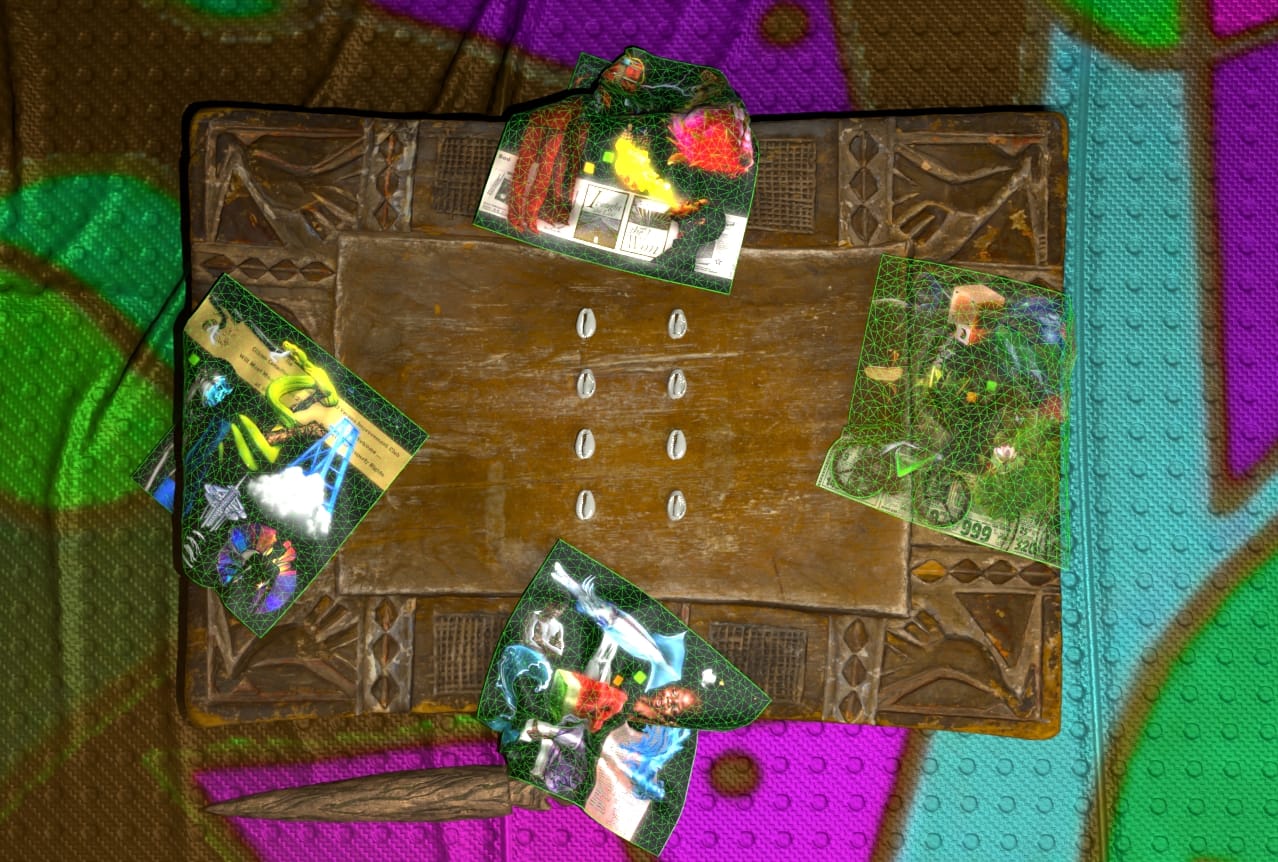
On the day my father visited the bokonon, the consultation started with his request and his concern about my career. After listening carefully to my father, the bokonon handed him an Agoumaga, a string of eight half kola nuts tied together in two rows, forming a kind of necklace. From top to bottom, each of these half nuts represents one of the four elements: fire, air, water, and earth. Agoumaga is a precious tool of divination, a working instrument that is consecrated through one or several sanctification ceremonies before becoming operational. It belongs to the bokonon who makes it, and it may be lent or can even be inherited.

My father was asked to whisper his concern to the Agoumaga and place it on the divination tray—a crucial detail, as it emphasizes the direct nature of the conversation with the Fá divinity instead of a mediation through the human diviner. It’s a deliberate design to minimize the diviner’s personal influence, channeling the client’s wishes directly to Fá. As Jacob Kẹhinde Olupọna, scholar of Religious Studies, and Rowland Abiodun, scholar of art and Black Studies, write in their book Ifá Divination, Knowledge, Power, and Performance, the act of whispering desires and concerns into the divination object brings the client’s past into the presence of the priest and engages the attention of the divination god’s representative. In that moment, the act of speaking isn’t just articulating a problem; it’s an energetic transference, a deep form of focused intent. It’s the first act of profound listening, not just by human ears, but by the universe itself, acknowledging and receiving the client’s deepest concerns. The Agoumaga is the servant of Fá and is considered a magical-sacred object.
That whisper stayed with me. In most encounters with institutions—a bank, a government office, an online platform—you begin by filling in a form, entering data, being categorized. The system processes you. But here, the first move was different: the system listened. Not to information, but to a person’s concern, spoken quietly, almost secretly, into a sacred object. The encounter began not with classification, but with acknowledgment. What would it mean to design systems that began that way? What if the first act of any institutional encounter—applying for a loan, seeking healthcare, navigating a legal process—was not to categorize you, but to genuinely hear you?
“The diviner began by praising Fá to invoke the spirit of the divinity and ensure the clarity of the response,” my father recounted, the process unfolding in his words. The act of praising Fá often involves striking a carved taper called Lofle against the wooden divination tray, the Fátè. The bokonon struck the Fátè, brushing over its engraved borders and stylized human head referring to the Vodun deity Legba. It produced a resonant tone, a sound believed to alert cosmic forces, preparing the spiritual atmosphere for communication.

The role of the bokonon then began. He lifted his Agoumaga, grasping it firmly at the center. He held the cord in his right hand, as the left hand is considered impure. He raised the instrument, touched the object with its extremities, and recited an incantation in the Fon language before he threw the divining chain in front of him.
The half nuts of the Agoumaga string landed in different positions. Some of the nuts pointed their openings to the top, some to the bottom, hiding the open part. “The bokonon closely observed each half nut and their position to read the pattern,” my father continued. The pattern that emerged from that reading determined an odù—a unique configuration representing a mathematically defined message. Each position of the eight nuts is viewed as a binary state: either opening to the top or bottom. These combinations add up to 256 possible patterns, yielding 16 principal odù and 240 minor ones. Each pattern is a unique cosmic fingerprint, and the pattern revealed to my father presented an answer to his concern in its own complex tapestry of meaning.
What struck me when I first learned this was the mathematics underneath it. The same binary logic—two states, zero and one—sits at the foundation of modern computing. Every digital system, every algorithm, every screen you read these words on, runs on variations of that same principle. However, when it appears in Fá, in the gaze shaped by colonial practices of naming, it is rarely called technology. It is called mysticism—a label practitioners themselves would not recognize. Yorùbá and Fon traditions describe the system through terms like alákọ̀wé, meaning a literate and learned means of inquiry, and awo, an esoteric knowledge accessed through years of rigorous study. In the Benin (Fon) tradition, practitioners such as Rémy T. Hounwanou argue for the rehabilitation of Fá as a “science.” In his book Le Fa: une géomancie divinatoire du golfe du Bénin, Hounwanou calls to “de-fetishize” the practice and “return it to its rightful place among the human sciences.”
“Certain knowledge systems such as those connected to European modernity were classified as rational; those belonging to non-European ways of thinking, as superstition.”
Fon tradition views Fá as a “ceaseless source of inspiration” and a system that governs the social, political, and cultural fabric of the people. Philosopher Yuk Hui offers a useful way to think about this. In The Question Concerning Technology in China, he argues that every culture develops technologies grounded in its own cosmology—its own understanding of the world, of what matters, of how things relate. Technology, in this view, is never neutral machinery. It is always an expression of a worldview. By that measure, Fá is not an archaic residue awaiting modernization. It is a technology in its own right—one that integrates ethics, mathematics, memory, and community into a single practice. The distinction between Fá and computation is not mathematical. It is historical. Certain knowledge systems such as those connected to European modernity were classified as rational; those belonging to non-European ways of thinking, as superstition. That classification had more to do with colonial power than with the actual complexity of the systems involved.
And yet, to suggest that Fá is simply an “early algorithm” or a “proto-computer” would be another form of reduction. That move would flatten its relational and ethical dimensions into technical abstraction—translating it into the very framework that once dismissed it. Fá is not computation. It is encounter. Its structure may be combinatorial, but its purpose is ethical. It doesn’t process a person. It meets them.
Co-Authorship
Once the odù appeared, the bokonon did not exercise choice. He chanted the verses of the odù whose signature was presented by the divining chain’s pattern, while my father watched and listened to stories rich with mythological characters, tricksters, kings, wanderers, and divinities, who faced various issues. The priest chanted as many poems as he knew from that odù, until he reached a poem that told a story that mirrored my father’s concern. And here’s the detail that truly shifted my perspective: my father interrupted the diviner. He didn’t wait for a full, uninterrupted recitation. He listened discerningly to the verses and selected the one he felt was most directly relevant to his situation.
That interruption was not rudeness. It was design. Fá anticipates it. The system is built expecting that the client will recognize their own story within the verses and speak up when they do. In other words, the client’s voice is not an interruption to the process—it is part of the process. The system doesn’t deliver a verdict; it offers a repertoire, and the client is the one who recognizes their own story within it. My father didn’t just receive wisdom; he participated in producing it. He actively mapped the allegorical message onto his own life, his own context, shaping the meaning of the consultation through the act of recognition and selection.
Think about how different that is from most systems we interact with today. When a streaming platform recommends a film, or an algorithm decides what news you see, there is no moment where you are invited to interrupt and say: “that one, that’s mine.” The process happens to you. Fá does not categorize a person—it situates them within narrative. It does not collapse uncertainty into certainty; it ritualizes uncertainty as space for reflection. Scholars like Ruha Benjamin have shown how supposedly neutral technological systems often reproduce social hierarchies under the guise of efficiency. In Race After Technology: Abolitionist Tools for the New Jim Code, Benjamin highlights that the problem is not just biased data, but a deeper logic that privileges categorization over conversation. Fá, by contrast, assumes you are a participant, not a recipient. It assumes you are the only one who can ultimately recognize what is true for your life. Imagine systems built on that assumption: governance that stages dialogue rather than decree; platforms that present possibilities rather than verdicts; institutions that assume the person in front of them is a co-author of the outcome, not merely a case to be processed.
“Fá isn’t merely about gaining knowledge; it’s about engaging in action, about completing a cycle of understanding and interaction.”
This co-authorship wasn’t a singular event. The bokonon repeated the process two more times, each casting of the Agoumaga revealing another layer, another facet of the initial concern. The first casting established the mythological precedent, the archetypal story that mirrored my father’s situation. The second casting revealed how that story was resolved, what outcome would emerge from that ancient dilemma. The third casting bridged the mythological and the personal, showing how this ancestral wisdom applied specifically to my father’s life, his choices, and his path forward. With each odù and its corresponding knowledge, the bokonon translated Fá’s parables into comprehensible advice. It was a process of iterative refinement, of deepening understanding through layers of meaning—from universal pattern, to resolution, to intimate application.
After the interpretation, the bokonon prescribed sacrifices, known as vossissas in Fon. My father explained their purpose: “If the prediction is favorable, the sacrifice helps ensure its fulfillment. If unfavorable, it helps avert impending misfortune.” He emphasized that performing these sacrifices was an integral and essential part of the divination process, without which the act remains incomplete. Fá isn’t merely about gaining knowledge; it’s about engaging in action, about completing a cycle of understanding and interaction. Knowledge, in this system, is never just information you store away. It asks something of you in return. The vossissas are not a transaction. They are a gesture of reciprocity, a reminder that insight and responsibility cannot be separated.
Choice
The more I sat with my father’s account, the more I began to understand that what had unfolded that day was not only a spiritual consultation. It was also something quietly political—not in the sense of party or government, but in a deeper sense: a question of who gets to speak, who interprets, and who decides.
In my father's consultation, that question had a clear answer: the final word was always his. The consultancy ultimately provided guidance, a path forward. But most importantly, my father was always expected to exercise his own agency. He was not bound by the pronouncements and could choose to re-consult to further refine his understanding, or to decide the extent to which he would follow or even reject the instructions. This is the third and perhaps most quietly radical dimension of Fá: choice. The system offers depth, not destiny. It respects individual autonomy, placing the ultimate responsibility and freedom of choice squarely on the client. It acknowledges human complexity and the messy, beautiful reality of free will, recognizing that universal truths find their most potent expression in individual lives.
“We live in a moment when more and more decisions that affect our lives are made by systems we cannot see, question, or refuse.”
This matters more than it might first appear. We live in a moment when more and more decisions that affect our lives are made by systems we cannot see, question, or refuse. Algorithms inform policing, credit scoring shapes opportunity, and recommendation engines structure what we know and believe. However, they tend to operate in only one direction. A decision is made. A recommendation appears on your screen. You receive it. The process that produced it is usually invisible, and your role in shaping it is minimal. These systems are often presented as neutral and objective—just math, just data. But they make choices about us without us.
Fá operates differently. Authority is staged, not imposed. Meaning emerges through dialogue. The bokonon does not announce destiny; he recites possibilities. The client does not submit; they recognize. The consultation does not end in finality; it ends in responsibility. Sitting with my father’s story, I found myself asking: What if more of our systems worked that way? What if we designed systems around the principle that Fá has held for centuries—that the final word always remains human? What if we built infrastructures that assume the person engaging with them is not a passive consumer, but a co-author? That uncertainty is not a problem to be eliminated, but a space to be inhabited together? Fá does not collapse uncertainty into a neat answer. It ritualizes uncertainty—it slows the encounter down, creates space for reflection, and ultimately returns the decision to the person who has to live with it. Fá does not optimize outcomes. It orients relationships. It does not seek to eliminate uncertainty. It teaches one how to inhabit it.
Realizing the relational nature of Fá, the way it binds knowledge to responsibility and guidance to freedom, has shifted how I understand my father’s initial concern about my artistic path. His consultation was not an attempt to surrender my future to divine decree. It was an attempt to widen the field of understanding, to situate my decision within a larger ancestral horizon. His anxiety was not about control. It was about care. And Fá, rather than replacing his judgment or mine, gave us both more to think with.
This experience, recounted by my father, illuminated for me how the three dimensions of listening, co-authorship, and choice are not separate features of Fá but a single, continuous act. The system listens, then invites you to shape what it has heard into meaning, then releases you to do with that meaning what you will. Each step depends on the one before. You cannot co-author what was never truly heard. You cannot exercise real choice over meaning that was never really yours to shape.
The wisdom of Fá, contained within the casting of the nuts and the recitation of ancient verses, is a vibrant, living testament to a different kind of human-system interaction—one that values deep listening, honors the intricacies of human experience, and invites us all to be active co-authors in the unfolding narrative of our lives. It is less about control and more about collaboration, less about efficiency and more about resonance.
“To imagine technologies otherwise is not to romanticize tradition or to reject the present.”
To imagine technologies otherwise is not to romanticize tradition or to reject the present. It is to question what we have come to accept as inevitable. The dominant systems governing our lives are not the only conceivable arrangements of knowledge and power. Fá stands as living evidence of that plurality. It shows that pattern recognition can coexist with poetry. That structure can coexist with story. That guidance can coexist with freedom. And perhaps, most importantly, that listening can be infrastructure.
In this sense, the renewed curiosity among young Beninese is not nostalgia. It is inquiry. It reflects a desire to reconnect with systems of meaning that were interrupted by colonial dismissal and modern acceleration. As we return to engage with it, we do not do so to retreat into the past, but to reconsider what forms of knowledge we allow to shape our futures.
For me, that reconsideration took the form of a making practice. As an artist working with new media, the research became a question not just of what Fá means, but of what it might feel like to encounter a system that begins differently. That speculation took shape as an interactive 3D Fá divination tray, a digital environment that does not attempt to replicate the practice but to imagine: What would a more attentive, more reciprocal technological encounter feel like if it were designed from Fá's premises?

This ancient practice, rooted in the spiritual landscape of West Africa, holds profound insights into what it means to build relationships with knowledge that are truly reciprocal and deeply human. It asks us to look closely at how we interact with the forces that shape our lives, and to consider that the systems we have are not the only systems we could have. As for me, I am still waiting for my own crossroads. But writing this, I sense it may be closer than I think.
Mahoutondji Kinmagbo (he/him) is a self-taught new media artist and creative technologist from the Benin Republic. With a background in finance, his artistic journey explores the intersection of African heritage and digital technology. Through immersive environments, speculative design, and digital storytelling, he investigates how identity, memory, and culture evolve in the digital age. His work reimagines ancestral narratives, offering new perspectives on the past while imagining possible futures. Rooted in personal and collective inquiry, his practice blends curiosity with experimentation, using technology not just as a tool but as a mirror to reflect on transformation and the continuity of cultural memory.
The text, images, and website were produced as part of the Unwired Currents—Imagining Technologies Otherwise fellowship under the mentorship of Iyo Bisseck and Mio Kojima.
The fellowship was part of the Unwired Currents—Imagining Technology Otherwise larger collaborative project between Dezentrum and Futuress, along with Dreaming Beyond AI, Franca López Barbera, and Matería Oscura. The program was possible thanks to a generous grant from the Swiss Arts Council Pro Helvetia.